
FIRE SERVICE LEADERSHIP DEVELOPMENT CASE STUDY
Developing Fire Service Leaders Across Delaware
A Statewide Leadership Development Case Study
From Firefighter to Officer: Leadership That Strengthens Officers, Departments, and the Fire Service
Delivered through the Delaware State Fire School | July–August 2026
Engagement Overview
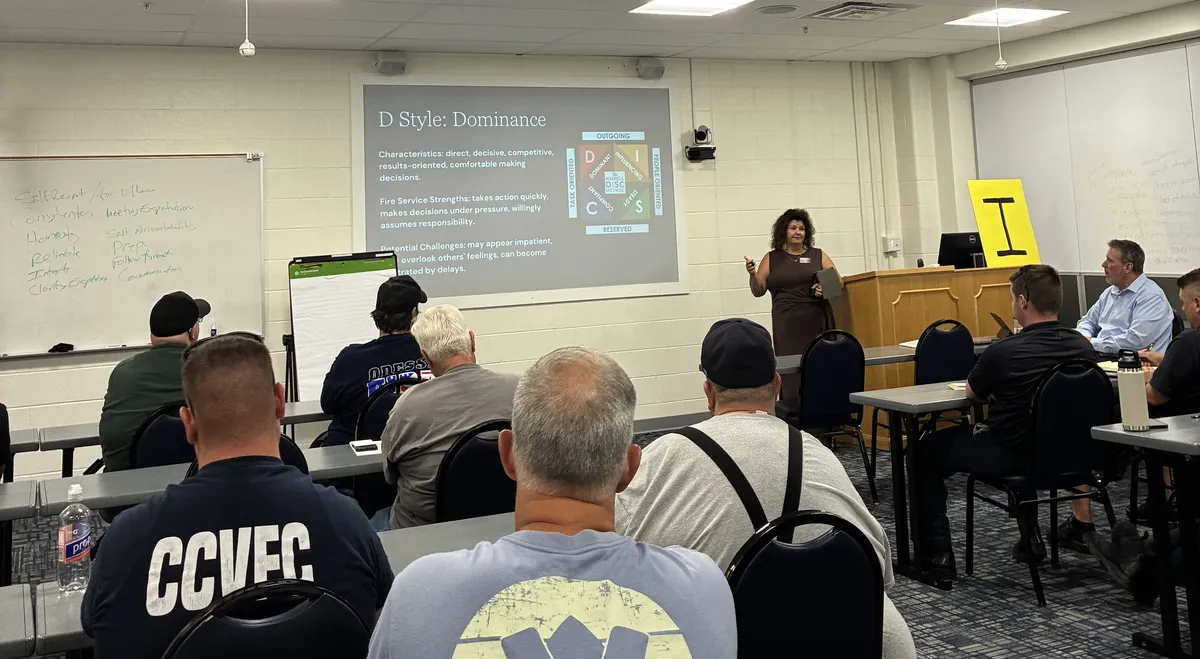
Justice Leadership Development delivered From Firefighter to Officer: Leadership That Strengthens Officers, Departments, and the Fire Service through the Delaware State Fire School at three locations across Delaware during July and August 2026. The four-hour leadership development program reached 70 fire-service personnel representing volunteer, career, and combination departments and a range of operational, support, administrative, and leadership responsibilities.
Statewide Results at a Glance
70
Fire-Service Personnel
3
Workshop Locations
4.40/5
Overall Statewide Rating
86.8%
Rated the Workshop 4 or 5
The Leadership Need
Fire-service leadership extends across the department, from firefighters and emerging leaders to company officers, chief officers, and department leadership. Regardless of rank or role, leadership behaviors influence communication, accountability, member development, department culture, and organizational effectiveness.
The statewide pre-workshop responses identified recurring leadership challenges affecting departments, including communication breakdowns, inconsistent expectations and accountability, conflict and difficult interpersonal issues, resistance to change, recruitment and retention concerns, generational differences, trust, succession, and the transition from peer to officer.
These findings reinforced the need for leadership development that connects individual leadership responsibility with the broader organizational conditions affecting department performance.
The Leadership Development Program
From Firefighter to Officer reflects the breadth of leadership across the fire service, from firefighters through officers and department leadership. The program was designed for fire-service personnel across levels of responsibility, recognizing that leadership behaviors and decisions influence people, culture, accountability, member development, and organizational effectiveness throughout the department.
The four-hour program focused on practical leadership concepts that participants could apply within their departments, including leadership responsibility, communication, accountability, difficult conversations, member development, department culture, and leading through organizational and generational change.
Evidence and Results
Participant evaluation data showed strong satisfaction with the statewide program and substantial interest in continued leadership development. Across the three workshop locations, the overall statewide workshop rating was 4.40 out of 5, with 86.8% of participants rating the workshop a 4 or 5.
Interest in continued leadership development was even stronger. Participants rated the importance of continued leadership development at an average of 4.74 out of 5, with 94.4% rating continued development a 4 or 5.
The evaluation findings also provided insight beyond satisfaction with the program. Written responses showed a statewide shift in how participants described leadership challenges and their own role in addressing them.
From Organizational Challenges to Personal Leadership Responsibility
Before the Workshop
Written responses primarily described leadership challenges as problems occurring within departments—including communication breakdowns, inconsistent accountability, resistance to change, conflict, generational differences, and other organizational concerns.
Following the Workshop
Written responses more frequently identified leadership actions within participants' own control, including communicating more intentionally, addressing issues directly, setting clearer expectations, holding people accountable, developing members, and considering how their own leadership behaviors influence others.
Because the pre- and post-workshop responses were not statistically matched at the individual participant level, these findings should be interpreted as a statewide shift in response patterns rather than measured individual behavior change. Even with that limitation, the pattern provides useful evidence that participants were connecting organizational leadership challenges with personal leadership responsibility.
Alignment with Fire Service Professional Qualifications
The leadership themes addressed through From Firefighter to Officer align with leadership-related competencies reflected in NFPA 1021: Standard for Fire Officer Professional Qualifications (2020) and carried forward in NFPA 1020: Standard for Fire and Emergency Services Instructor, Fire Officer, and Emergency Medical Services Officer Professional Qualifications (2025). Relevant areas include communication, personnel leadership, accountability, member development, health and safety awareness, organizational effectiveness, and leadership during emergency operations.
This alignment provides a professional-standards context for the leadership development delivered through the program. From Firefighter to Officer was not designed as an NFPA certification course, does not replace required Fire Officer education or certification, and does not address every Job Performance Requirement contained within the applicable NFPA standards.
What the Evaluation Revealed Next
The statewide evaluation confirmed strong interest in continued leadership development while also identifying areas where participants want additional practical application. Recurring areas for future development included peer-to-officer transition, difficult conversations, conflict resolution, accountability, coaching and mentoring, progressive discipline, member engagement, generational leadership, department culture, leading change, and decision-making under pressure.
These findings provide a practical foundation for developing future leadership education around the challenges fire-service personnel are encountering within their departments rather than treating leadership development as a one-time training event.
Organizational Implications
The statewide findings demonstrate that fire-service leadership challenges are not isolated to individual leaders or single departments. Communication, accountability, conflict, member development, succession, resistance to change, and department culture are interconnected organizational issues that can directly affect consistency, engagement, leadership capacity, and overall department effectiveness.
Leadership development is therefore most effective when it extends beyond individual leadership knowledge and connects leadership behaviors to the systems, expectations, relationships, and organizational conditions in which people are expected to perform.
For fire-service organizations, the findings reinforce the value of developing leadership capability across levels of responsibility while also examining the organizational conditions that either support or hinder effective leadership.
Conclusion
The statewide From Firefighter to Officer initiative demonstrated both the demand for practical fire-service leadership development and the value of using participant feedback to identify where continued development should be focused.
Across three workshop locations, 70 fire-service personnel participated in a common leadership-development experience while providing statewide insight into the leadership challenges affecting their departments and the areas in which additional development is needed.
The result was not simply the delivery of three workshops. It was the establishment of a statewide leadership-development foundation and an evidence base for determining what fire-service leaders and members need next.
About Justice Leadership Development
Justice Leadership Development, founded by Jo Ann Justice, provides organizational performance consulting, leadership development, executive coaching, corporate training, keynote speaking, human resource advisory services, DISC behavioral analysis, and practical workplace AI education and implementation guidance.
Justice's organizational-performance work focuses on identifying conditions affecting consistent performance and strengthening leadership, accountability, communication, organizational systems, and workforce capability.
Jo Ann Justice is an Executive Director of the Maxwell Leadership Certified Team and is certified to facilitate, speak, train, and coach individuals and groups in leadership development, professional skills, and personal growth.
Through programs such as From Firefighter to Officer, Justice Leadership Development brings this organizational-performance perspective to the fire service, connecting individual leadership behaviors with communication, accountability, member development, department culture, and organizational effectiveness.
Strengthen Leadership Across Your Organization
Leadership challenges rarely exist in isolation. Justice Leadership Development works with organizations to identify the leadership, accountability, communication, people-development, and organizational conditions affecting consistent performance—and to develop practical solutions aligned with the organization's needs.


